
Turkish Food Codex Update
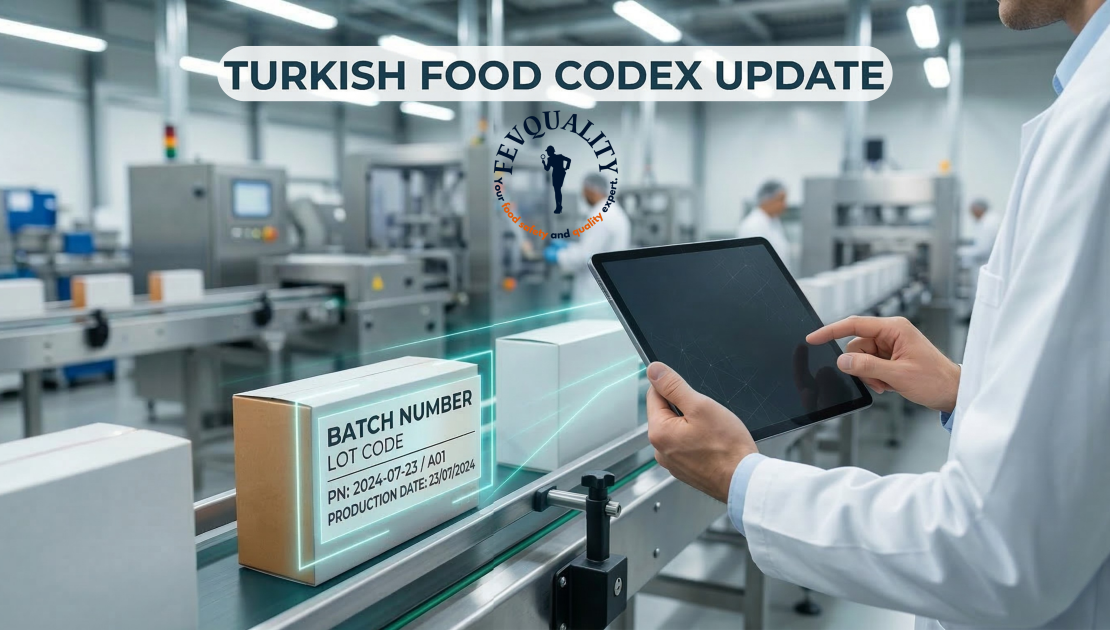
Demystifying the 2026 Turkish Food Codex Update: What the New Lot Identification Rules Actually Mean
Let’s be honest. Keeping track of every single batch of food in a complex supply chain can be a massive headache. But when a recall inevitably happens, a solid traceability system is the only thing standing between a minor logistical hiccup and a full-blown brand disaster.
The Turkish Ministry of Agriculture and Forestry clearly agrees. On 11 March 2026, they published a significant overhaul to the rules governing how we track our food. The new “Turkish Food Codex Communiqué on Marks or Numbers Identifying the Lot to Which Foods Belong” (Communiqué No: 2026/11) has officially replaced the outdated 2012 guidelines.
If you are involved in food production, retail, or contract manufacturing, you need to pay attention. The old grey areas are gone. In their place is a much stricter framework designed to harmonise with EU Directive 2011/91/EU.
So, what exactly has changed on the factory floor? Let’s look at the practical differences.
The ‘Lot’ Has a New, Stricter Definition
Under the previous 2012 rules, the definition of a “lot” (or parti in Turkish) was surprisingly vague. The 2026 update fixes this by clamping down on the specifics.
From now on, for products to be considered part of the same lot, they must share the exact same raw materials, the same production method, and be produced within the same timeframe. Crucially, the packaging must also be identical in size, type, and class. You can no longer group slightly different runs under one convenient batch number. The goal here is simple: if a recall happens, it needs to be laser-targeted.
Who is Actually Responsible?
When there is an issue with labelling, the blame game usually starts across the supply chain. The updated Communiqué cuts through the noise. It introduces very clear, distinct definitions for both the “food business operator” and the “food producer”.
The responsibility for actually determining the lot and putting that mark on the packaging now rests entirely with the food producer. It brings a much-needed level of accountability to the system.
The Rules for ‘P’ and ‘L’ Marks
If your lot number isn’t immediately obvious from the rest of the text on your label, it now legally has to start with the letter “P” or “L”.
There is an exception, though. You can still use your production date, best-before date, or expiry date as the lot identifier—as long as it clearly shows at least the day and the month. But here is the catch: if you do this, your packaging must explicitly explain it. You will need a phrase along the lines of, “The lot number is the production date/expiry date” printed clearly on the label.
Paperwork is No Longer Optional
It’s one thing to print a number on a box; it’s another to prove what it means. The new legislation creates a hard legal requirement for producers to keep detailed records. If an inspector turns up, you must be able to show the paper trail proving your lot numbers align perfectly with the strict new definitions.
Are There Any Exceptions?
Yes. The Ministry hasn’t completely ignored the practical realities of selling food. You don’t need a lot number for:
-
Agricultural products just moving to temporary storage.
-
Foods sold loose and unpackaged, or packed right in front of the customer.
-
Tiny packaging where the largest surface is less than 10 cm².
-
Individual ice cream portions (as long as the lot number is on the main outer box).
The Deadline
Although the rules are live, there is a grace period. Food businesses have until 31 December 2026 to update their labels, tweak their production lines, and get their paperwork in order. After that, non-compliant products won’t be allowed on the shelves.
Adapting to these kinds of regulatory updates takes time, and the margin for error is getting smaller—especially if you rely on complex supply chains or external manufacturers.
Need help staying ahead of the curve?
-
🇹🇷 Operating in Türkiye? Understanding the finer details of the Food Codex is vital, especially when managing contract manufacturing. For expert, up-to-date training designed to keep your Turkish operations flawless, head over to Fevkalite.net.
-
🇬🇧 Based in the UK? If you are managing suppliers and need absolute confidence that your supply chain is resilient and audit-ready, professional oversight is key. Discover how our thorough supplier auditing services can protect your brand at Fevquality.co.uk.
“The only thing we need to create a successful team is to work together.”
Author: Akakan Akay
Bibliography
-
T.C. Resmî Gazete. (11 Mart 2026). Türk Gıda Kodeksi Gıdaların Ait Olduğu Partiyi Tanımlayan İşaretler veya Numaralar Hakkında Tebliğ (Tebliğ No: 2026/11). Sayı: 33193. Tarım ve Orman Bakanlığı.
-
European Parliament and Council. (13 December 2011). Directive 2011/91/EU on indications or marks identifying the lot to which a foodstuff belongs. Official Journal of the European Union.
-
T.C. Tarım ve Orman Bakanlığı. (2010). Veteriner Hizmetleri, Bitki Sağlığı, Gıda ve Yem Kanunu (Kanun No: 5996). T.C. Resmî Gazete.
-
T.C. Cumhurbaşkanlığı (2010). 5996 Sayılı Veteriner Hizmetleri, Bitki Sağlığı, Gıda ve Yem Kanunu. 13 Haziran 2010 Tarihli ve 27610 Sayılı Resmî Gazete